
Tuesday, September 1, 2015

Friday, August 21, 2015
Tuesday, August 11, 2015
National Anthem
 |
| Indian Flag |
Sunday, August 2, 2015
What is Computer?
 |
| Computer System |
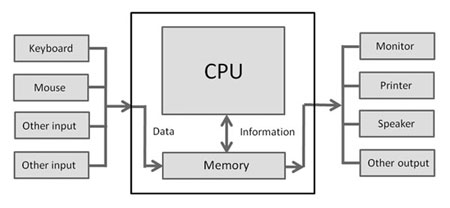
What is Computer : Computer is an electronic device that is designed to work with Information. The term computer is derived from the Latin term ‘computer’, this means to calculate or programmable machine. Computer can not do anything without a Program. It represents the decimal numbers through a string of binary digits. The Word 'Computer' usually refers to the Center Processor Unit plus Internal memory.
Charles Babbage is called the "Grand Father" of the computer. The First mechanical computer designed by Charles Babbage was called Analytical Engine. It uses read-only memory in the form of punch cards.
Computer is an advanced electronic device that takes raw data as input from the user and processes these data under the control of set of instructions (called program) and gives the result (output) and saves output for the future use. It can process both numerical and non-numerical (arithmetic and logical) calculations.
Digital Computer Definition
The basic components of a modern digital computer are: Input Device, Output Device, Central Processor Unit (CPU), mass storage device and memory. A Typical modern computer uses LSI Chips.
Four Functions about computer are:
accepts data
|
Input
|
processes data
|
Processing
|
produces output
|
Output
|
stores results
|
Storage
|
Input (Data):
Input is the raw information entered into a computer from the input devices. It is the collection of letters, numbers, images etc.
Process:
Process is the operation of data as per given instruction. It is totally internal process of the computer system.
Output:
Output is the processed data given by computer after data processing. Output is also called as Result. We can save these results in the storage devices for the future use.
Computer Classification: By Size and Power
Computers differ based on their data processing abilities. They are classified according to purpose, data handling and functionality.
According to functionality, computers are classified as:
• Analog Computer: A computer that represents numbers by some continuously variable physical quantity, whose variations mimic the properties of some system being modeled.
• Personal computer: A personal computer is a computer small and low cost. The term "personal computer" is used to describe desktop computers (desktops).
• Workstation: A terminal or desktop computer in a network. In this context, workstation is just a generic term for a user's machine (client machine) in contrast to a "server" or "mainframe."
• Minicomputer: A minicomputer isn't very mini. At least, not in the way most of us think of mini. You know how big your personal computer is and its related family.
• Mainframe: It refers to the kind of large computer that runs an entire corporation.
• Supercomputer: It is the biggest, fastest, and most expensive computers on earth.
• Microcomputer: Your personal computer is a microcomputer.
Monday, July 13, 2015
How to create Wi-Fi Hotspot using command line in Windows
 |
| Wifi Hotpot |
Step1:
Open the command prompt admin. In case of Windows 8 and above you can do this by pressing “Windows logo + x ” and select the power shell or command promt (Admin) as shown in the screenshot below.

Step2:
At first you had to check whether your wifi adapter supports hosted network mode or not.
So type the command “netsh wlan show drivers” and press enter. If it is Yes then you can create a hotspot, otherwise you have to upgrade your wifi adapter or drivers.

Step3:
Considering that your adapter has support for hosted network mode, type the command
netsh wlan set hostednetwork mode=allow ssid=name_of_your_choice key = your_password
as on the frist window below. Here type the name of your choice in place of ”name-of-hotspot” and your password in place of “your-password-key

Step4:
Next type the command “netsh wlan show hostednetwork” and press enter. You can see that status is not started for the hotspot.

Step5:
Next Type the command “netsh wlan start hosted network " to start the hotspot and press enter.

Step6:
To stop the hotspot you just have to type Stop instead of Start in the above command.
That is ”netsh wlan stop hosted network"
Step 6:
Now for the last step all you have to do after creating a hotspot is ,
go to the change adapter settings and select the network(Ethernet) you want to share and click on it’s properties and select the sharing tab and enable the option to share your internet with others.
Now that your Wi-Fi hotspot is created , enjoy the seamless browsing with your other devices.
Wednesday, July 8, 2015
Prime number
"Prime" redirects here. For other uses, see Prime (disambiguation).
A prime number (or a prime) is a natural number greater than 1 that has no positive divisors other than 1 and itself. A natural number greater than 1 that is not a prime number is called a composite number. For example, 5 is prime because 1 and 5 are its only positive integer factors, whereas 6 is composite because it has the divisors 2 and 3 in addition to 1 and 6. The fundamental theorem of arithmetic establishes the central role of primes in number theory: any integer greater than 1 can be expressed as a product of primes that is unique up to ordering. The uniqueness in this theorem requires excluding 1 as a prime because one can include arbitrarily many instances of 1 in any factorization, e.g., 3, 1 · 3, 1 · 1 · 3, etc. are all valid factorizations of 3.The property of being prime (or not) is called primality. A simple but slow method of verifying the primality of a given number n is known as trial division. It consists of testing whether n is a multiple of any integer between 2 and
 . Algorithms much more efficient than trial division have been devised to test the primality of large numbers. Particularly fast methods are available for numbers of special forms, such as Mersenne numbers. As of April 2014[update], the largest known prime number has 17,425,170 decimal digits.
There are infinitely many primes, as demonstrated by Euclid around 300 BC. There is no known useful formula that sets apart all of the prime numbers from composites. However, the distribution of primes, that is to say, the statistical behaviour of primes in the large, can be modelled. The first result in that direction is the prime number theorem, proven at the end of the 19th century, which says that the probability that a given, randomly chosen number n is prime is inversely proportional to its number of digits, or to the logarithm of n.
Many questions regarding prime numbers remain open, such as Goldbach's conjecture (that every even integer greater than 2 can be expressed as the sum of two primes), and the twin prime conjecture (that there are infinitely many pairs of primes whose difference is 2). Such questions spurred the development of various branches of number theory, focusing on analytic or algebraic aspects of numbers. Primes are used in several routines in information technology, such as public-key cryptography, which makes use of properties such as the difficulty of factoring large numbers into their prime factors. Prime numbers give rise to various generalizations in other mathematical domains, mainly algebra, such as prime elements and prime ideals.
Definition and examples
A natural number (i.e. 1, 2, 3, 4, 5, 6, etc.) is called a prime number (or a prime) if it has exactly two positive divisors, 1 and the number itself.[1] Natural numbers greater than 1 that are not prime are called composite.
- 4 = 2 · 2.
- 6 = 2 · 3.
If n is a natural number, then 1 and n divide n without remainder. Therefore, the condition of being a prime can also be restated as: a number is prime if it is greater than one and if none of
- 2, 3, ..., n − 1
- n = a · b.
The set of all primes is often denoted by P.
The first 168 prime numbers (all the prime numbers less than 1000) are:
- 2, 3, 5, 7, 11, 13, 17, 19, 23, 29, 31, 37, 41, 43, 47, 53, 59, 61, 67, 71, 73, 79, 83, 89, 97, 101, 103, 107, 109, 113, 127, 131, 137, 139, 149, 151, 157, 163, 167, 173, 179, 181, 191, 193, 197, 199, 211, 223, 227, 229, 233, 239, 241, 251, 257, 263, 269, 271, 277, 281, 283, 293, 307, 311, 313, 317, 331, 337, 347, 349, 353, 359, 367, 373, 379, 383, 389, 397, 401, 409, 419, 421, 431, 433, 439, 443, 449, 457, 461, 463, 467, 479, 487, 491, 499, 503, 509, 521, 523, 541, 547, 557, 563, 569, 571, 577, 587, 593, 599, 601, 607, 613, 617, 619, 631, 641, 643, 647, 653, 659, 661, 673, 677, 683, 691, 701, 709, 719, 727, 733, 739, 743, 751, 757, 761, 769, 773, 787, 797, 809, 811, 821, 823, 827, 829, 839, 853, 857, 859, 863, 877, 881, 883, 887, 907, 911, 919, 929, 937, 941, 947, 953, 967, 971, 977, 983, 991, 997 (sequence A000040 in OEIS).
Saturday, June 27, 2015
ICT STD IX (Chapter 1. CONCEPTS AND NECESSITY OF ICT)
1. Concepts and necessity of ICT
Ans:- ICT is the abbreviation for information and communication Technology, which is a combination of information processing and Communications systems and the application software’s that are Used to create, store, transmit, analyse, manipulate and share information In its various forms.
Q.2 State the implications of ICT in education.
Ans:- The trend towards an information based society with widespread use Of Information and communication Technology (ICT) is expected to shape the
Learning process and learning environment in the future some of the implication of ICT in education are as follows.
1) ICT- enabled learning will be crucial in acquiring up-to-date knowledge. And new skills to remain socially competitive.
2) ICT can provide different and better learning options, and thus make self-learning Faster and more interesting.
3) ICT enables “anytime, anywhere” learning. It can provide the learner the flexibility to Choose to time pace and place to learn.
4) ICT can overcome physical and geographical barriers to connect learning individuals to share ICT literacy and ICT skills are necessary for employment, self-development and active participation in modern society. To live in this digitalised and networked society, the new generation need to learn the technologies involved in ICT, and the skills to operate them.
5) Lectures by excellent teacher from all over the world can be brought to classrooms anywhere in the world using modern communication technologies.
6) Students in a classroom can directly interact with scientists and discuss on real life issues and problems.
Q.3 State the uses of ICT in day-to-day life.
Ans:- Information and communication technology (ICT) has transformed the way people work, learn and have fun some of the broad application areas of ICT are as follows.
1) Business :- ICT helps a seller in business transaction with customers and suppliers, as well as remains up to date withal aspects of his/her business sales, expenses, etc
2) Industry:- computer are used in designing, automated manufacturing inventory control etc.
3) Home:- A computer at home can be used for playing games as well as for personal accounting shopping various banking transactions including bill payment playing games and communicating are possible through the Internet.
4) Education and training:- Multimedia educational software’s and Internet connectivity can motivate and make learning at all levels a rich experience. Training using ICT is easier and cheaper.
5) Entertainment and arts:-computer are now exclusively used for editing cine films, creating special effects and animations composing music creating illustrations and cartoons, and restoring still pictures.
Q.4 State the role of ICT in science and technology.
Ans:- Digital computers were invented for performing long, time consuming scientific calculation quickly. Today’s fast computers can create and display virtual reality scenarios on the computer monitor. Scientists use simulations to test scientific theories’ as well as to perform risky experiment’s, such as those involving explosive or toxic materials. A flight simulator is now invariably used to teach trainee pilots various controls of an aeroplane. This allows the trainee to practise all the controls under normal as well as emergency situation before actually flying a plane, thus minimising the risk of loss of life and property.
Simulations of surgical procedure allow medical students to learn and practise a surgery, and its intricacies and risks, without dangering a patient’s life. Another use of computer simulations in medicine is for testing a new drug before it can be allowed to be used for humans. The earlier practise of using animals for drug testing is now banned because of ethical implications.
Q.5 Sate the advantages of ICT.
Ans:- ICT is increasingly used in the field of education because of its following advantages.
1) ICT can make education accessible to all. With the use of various communication technologies, like radio conferencing and the Internet, is possible to provide education to provide education to people who are isolated by geographic, social and infrastructural barriers.
2) ICT infuses greater efficiency in education learning can continue even outside an educational institution. A learner can access study materials or recorded lectures of subject experts even from home.
3) The use of ICT can highly motivate and engage a learner. It helps in visualising many abstract concepts, fosters enquiry and stimulates the learner to explore further, on the other hand a slow learner can use ICT to learn and practise the basic skills at his own pace.
4) Teachers can use ICT to develop good teaching materials and also to expose the students to a world of information.
5) Learning through the use of ICT can provide opportunities and motivation for learning anywhere, anywhere, any time and at any age. Thus, ICT has the potential to fulfil the long-standing inspirational concepts of learning as lifelong activity.
6) The use of ICT can help an educational institution in the administrative and academic management of the institution, e.g. student admission and assessment pay roll and accounting library information system, etc.
 |
| ICT LOGO |
Friday, February 20, 2015
Paragraph on the Memorable Day of My Life!
Paragraph on the Memorable Day of My Life
The memorable day of my life would be the day when I came to know I was the second to score the highest in commerce in my town. I could not believe my ears as I never dreamed of such achievements. It was the memorable day of my life because I was able to see the happiness in my mother’s eyes. I thought she would cry. But she didn’t. She gave me a warm hug and told she knew I could do this. That day I realized my mother knew me more than me.
Scores or rank was a big reason to be happy. But, what was precious to me was my mother’s confidence in me. She was the one who never thought twice to be always by my side. Her love and affection for me was unconditional. She wanted me to be a self dependant woman. And I made her dream come true. Another reason why I consider the day as a memorable day of my life because I was able to outshine my biggest competitors. There were too many of them. Those students were smart, intelligent and dedicated.
I was determined to work hard and score as much higher as possible. I knew that I’ll win a good rank and be in a good position to get a place in one of the premier colleges. But, the results of my hard word were beyond expectation as I was the second from the top. That day I came to know that I should never doubt my abilities and have faith in myself. Courage, determination and my mother’s prayers were the three most powerful driving factors for me. My mother was my biggest support system during the time of struggle and distress. So yes, the memorable day of my life was the day when I could give my mother the most beautiful reason to be happy.
Subscribe to:
Posts (Atom)